The Renewable Energy System
Engineered for
Continuity.
Designed to Preserve Choice.
At this Pacific Northwest Benewah Estate, grid power was always available and remains available. The owners nevertheless chose to build a four-layer energy-efficient, renewable-energy system designed by an electrical engineer around carefully selected commercial-grade components: Canadian Solar bifacial generation, Schneider Electric conversion and control, American Battle Born LiFePO₄ storage and a backup propane reserve. The electrical architecture remains grid tie-in ready should a future owner ever choose to connect. Four years later, the system has proven itself reliable from season to season in daily residential use.
The Architecture
Four Layers.
One Engineered System.
Most homes depend on a single power source. At this Pacific Northwest Benewah Estate, four coordinated layers are designed for reliability, scalability, serviceability, long-term performance and continuity — times when grid service is interrupted by inclement weather, accidents or other unexpected events. Solar generation, Schneider control, Battle Born storage and redundant backup power operate as one integrated system, delivering normal residential power while preserving a grid-ready connection at any time. Thus, for this estate, power is always available because it’s generated on-site — clean, renewable, energy-efficient electricity, all day, every day, from season to season.
Primary Generation
12 kW Solar Array
6 towers · Canadian Solar bifacial panels · MIT-research-informed geometry
Conversion & Control
13.6 kW Charge Controllers/Inverters
Schneider · 2 × 6.8 kW · Integrated source management
Battery Storage
26 kWh LiFePO₄ Reserve
Battle Born USA · LiFePO₄ chemistry · Deep-cycle storage
Supplemental Power
Generator + Grid Option
Generator · 2 × 1,000-gal LP · Grid accessible
Layer I · Power Generation
Designed Around Winter Light.
Built to Prove What Research Discovered.
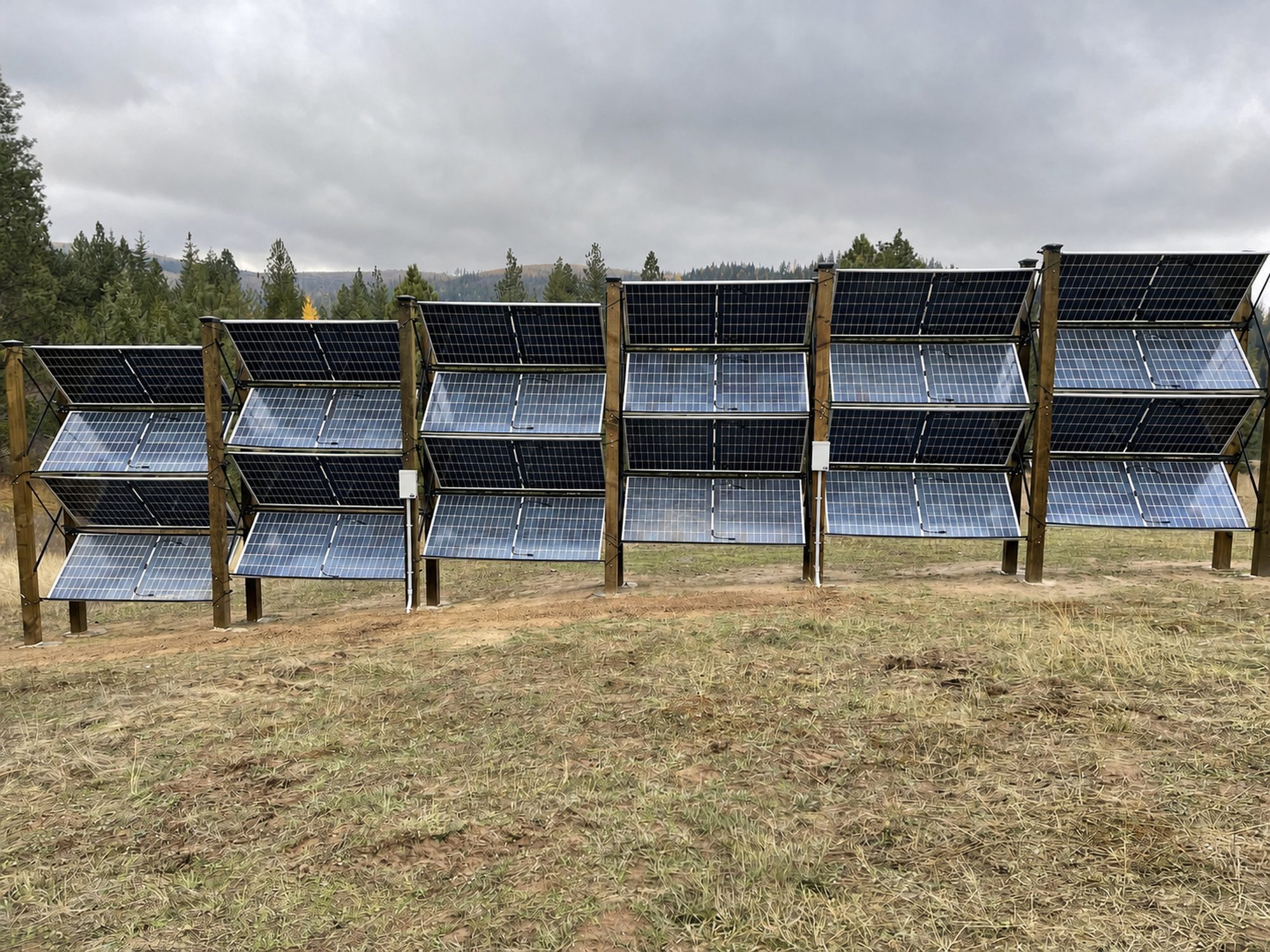
Six Freestanding Photovoltaic Towers · 12 kW Total Generation
Rather than mount conventional panels on the residence or arrange them in a detached planar array, 6 freestanding photovoltaic towers were engineered for mountain wind loading and optimized power generation. Bifacial panels were positioned at multiple vertical and angular orientations, with geometry informed by MIT research.
MIT researchers discovered three-dimensional panel configuration improved energy production by 2 to 20 times over stationary flat-panel arrays occupying the same ground area. The three-dimensional configurations also doubled peak-generation hours and substantially reduced the seasonal, latitude and weather variability associated with conventional flat-panel designs. Ironically, the strongest relative gains occurred in winter, under cloudier conditions further from the equator—the precise conditions of the Idaho Panhandle.
Panel selection was as consequential as tower geometry. Canadian Solar was chosen over lower-cost Chinese-branded/white-label commodity panels common to more budget focused installations. The distinction extends well beyond bifacial collection. Module construction, quality control, resistance to moisture, thermal cycling, microcracking and hot spots, long-term output retention, warranty depth and manufacturer support all influence whether a panel simply performs when new or continues producing reliably through decades of exposure.
At Benewah Estate, Tier 1 bifacial panels and cutting-edge tower geometry form Layer I of a four-layer architecture engineered to deliver municipal-grade power. All components of the system were as meticulously selected for maximum optionality, longevity, reliability and peak performance.
The Winter Advantage
Winter Becomes an Asset.
Winter is another way power generation has been leveraged at Benewah Estate.
Fresh snow has exceptionally high albedo, reflecting roughly 80–90% of incoming sunlight—as much as twice the share reflected by sand on a Florida beach beneath the hot summer sun. While the beach feels brighter and hotter, snow is actually the more reflective surface.
As sunlight enters the snowpack, it is repeatedly refracted and scattered among its ice crystals and air spaces before being redirected upward. This produces a broad field of diffuse reflected irradiance that reaches the rear surfaces of the estate’s bifacial panels, adding to the direct sunlight collected on their front faces. NREL reports that tested bifacial panels achieved highest gains with snow on the ground, while international photovoltaic research confirms snowy conditions materially increased rear-side irradiance and bifacial production. Accordingly, the array achieved power production targets and supported daily residential power consumption.
The towers’ steeply angled panels also provide a winter maintenance advantage. Through four North Idaho winters, the panels have never required snow removal.
Rather than merely enduring winter, the system’s design leverages it.
Canadian Solar
Engineered Beyond Initial Output.
The estate’s bifacial modules were selected not only for rear-side generation, but for long-term output retention, mechanical durability, extended qualification testing, warranty support and the strength of an established manufacturer.
Maker & Details
Canadian Solar was selected over lower-cost Chinese-branded and white-label commodity panels commonly used where initial price outweighs long-term performance. The distinction is not whether an inexpensive panel can generate electricity when new; most can. The distinction is how consistently it performs after years of moisture exposure, temperature cycling, mechanical loading, ultraviolet radiation and ordinary material degradation.
Canadian Solar’s module engineering addresses the failure mechanisms that determine long-term production: light-induced degradation, microcracking, hot spots, moisture intrusion, structural loading and declining output. Its bifacial construction adds rear-side generation from reflected and diffuse irradiance, while its materials, quality controls, testing and warranty support address the larger requirement—reliable production over the operating life of the system.

The Research Behind the Geometry
MIT research demonstrated that three-dimensional photovoltaic structures could produce materially more energy from the same ground area, extend peak-generation hours and reduce the seasonal disadvantages associated with conventional planar arrays.
Research & Technical Basis
MIT researchers used computational modeling and outdoor experiments to determine whether photovoltaic surfaces could collect more energy when arranged vertically in self-supporting, three-dimensional forms rather than conventional planar arrays. The structures studied generated 2–20× more energy per unit of ground area than stationary flat panels. By comparison, dual-axis tracking increased flat-panel production by only 1.3 to 1.8 times. Thus, for the same footprint angular geometry captured more solar energy during the weakest parts of the day and year when flat panel arrays are least productive.
The advantage arose because vertical and angular surfaces collected sunlight from multiple directions—particularly during mornings, evenings, winter months, cloudy weather, and at locations farther from the equator, when the sun remains lower on the horizon. The resulting production was not only greater within the available footprint, but more evenly distributed: the three-dimensional structures doubled peak-generation hours and substantially reduced variations caused by season, latitude, and weather.
The structures required more photovoltaic surface area—approximately 1.5× more per unit of energy under study conditions—but concentrated substantially more generation into a limited ground footprint while producing a steadier daily and seasonal power profile. Researchers concluded self-supporting three-dimensional forms offered a new approach to photovoltaic installation, opening pathways toward solar generation at terawatt scale.

Generation is only the first layer. Inside the dedicated photovoltaic structure, Schneider equipment directs the power the towers produce while Battle Born storage holds it in reserve.
Layers II & III · Control & Storage
Power Directed.
Energy Held in Reserve.
The towers generate the power. Schneider decides where it should go. Battle Born holds the excess in reserve.
Inside the dedicated photovoltaic structure next door to the residence, dual Schneider XW Pro inverter/chargers coordinate solar production, 26 kWh of LiFePO₄ storage, household demand, automatic generator reserve, and any future grid input. Together, these two layers transform variable solar generation into a stable residential utility.
Its sophistication is measured not by how much attention it demands, but by how little. The household uses power normally while Schneider manages the complexity invisibly.
What does that mean in practical terms? Consider a typical household moment: two family members are showering just as the scheduled irrigation cycle begins. Schneider coordinates available solar generation and stored Battle Born energy so the well pump starts under the combined load while the freezer stays cold and the laundry continues its cycle. If the same demand occurs at 2 a.m., after stored power has fallen below a programmed threshold, the system calls the generator automatically—without anyone interrupting a late-night snack or stepping outside. The household continues normally. The family never notices. The system manages the complexity invisibly.
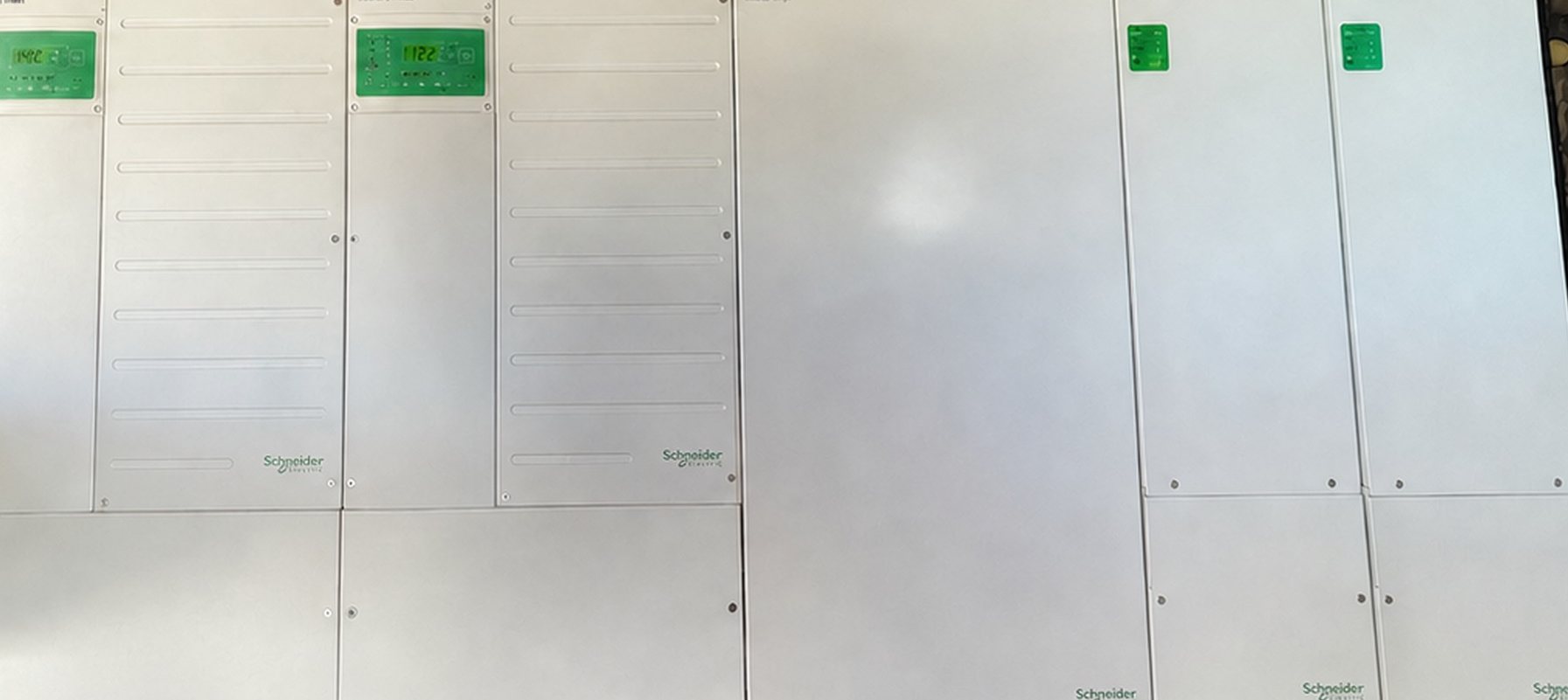
Dual Schneider XW Pro Inverter/Chargers · Conversion, Charging and Source Management
Layer II · Conversion & Control
Schneider Electric
Commercial-Grade Control.
Dual Schneider XW Pro inverter/chargers form the system’s control center, converting and directing power among solar generation, battery storage, household demand, automatic generator reserve and any future grid connection.
13.6 kW COMBINED · 2 × 6.8 kW XW PRO · MPPT CHARGE CONTROL · INSIGHT ENERGY MANAGEMENT
Maker & Details
Backed by more than a century of industrial electrical engineering, Schneider Electric is a global benchmark in heavy-duty energy infrastructure. The owners selected Schneider rather than the lightweight, high-frequency inverter packages commonly used in lower-cost, limited-duty installations.
Each XW Pro uses a substantial low-frequency toroidal transformer designed for continuous workloads and demanding surge conditions. Each installed 6.8 kW inverter/charger can provide up to 12 kW of short-duration surge capacity, allowing heavy inductive loads—such as pumps, compressors and motors—to start without destabilizing the system.
Schneider MPPT charge controllers and Insight energy management coordinate solar generation, battery charging, household demand, automatic generator input and future grid service. The architecture is programmable, monitorable and expandable, with the ability to support grid interaction, peak-load management and multiple operating configurations.
This is not a lightweight consumer inverter package. It is the conversion and control architecture at the center of a private residential utility.

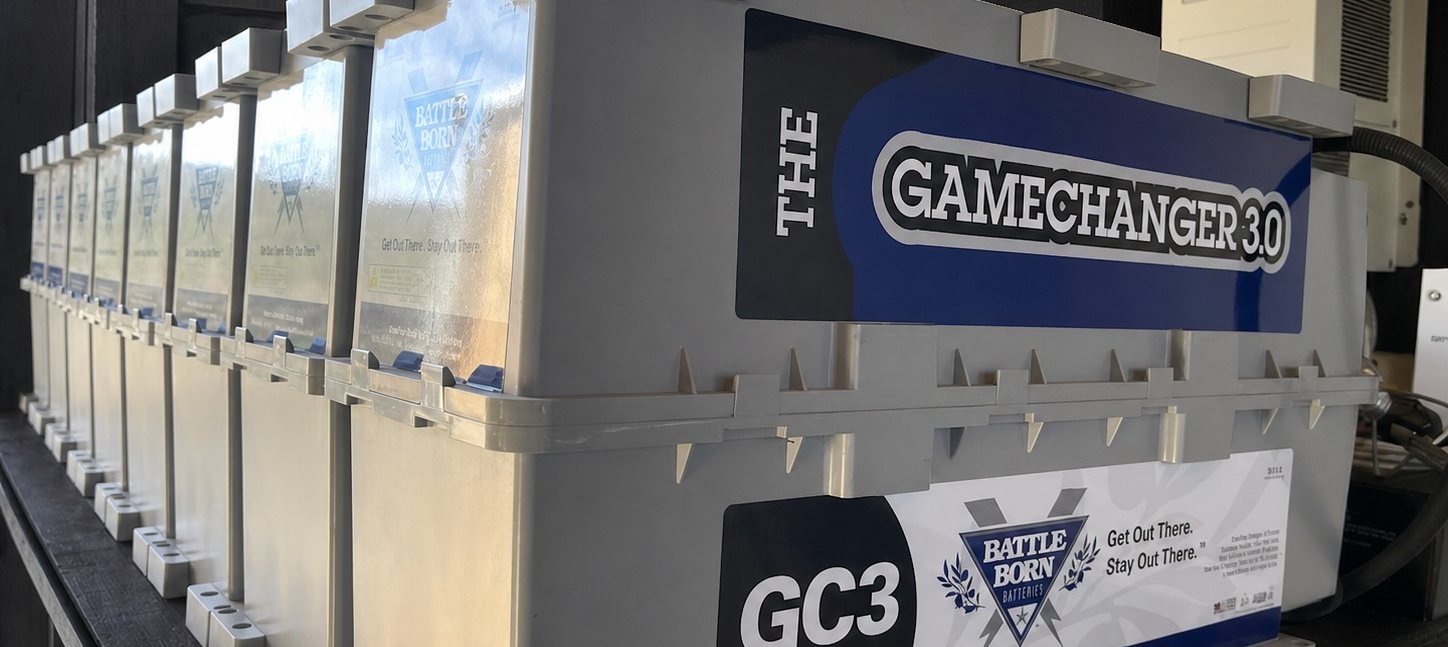
Battle Born LiFePO₄ Battery Bank · 26 kWh Reserve
Layer III · Battery Storage
Battle Born Batteries
American Energy Storage.
Battle Born LiFePO₄ batteries store solar production for use beyond active generation periods, creating the reserve that allows the array to function as a household utility rather than generation alone.
26 kWh · LiFePO₄ CHEMISTRY · INTEGRATED BATTERY MANAGEMENT · RENO, NEVADA
Maker & Details
Engineered and assembled in Reno, Nevada, Battle Born Batteries by Dragonfly Energy were selected for long-term cycling performance, integrated protection and direct American engineering support—not simply for initial storage capacity.
Lithium iron phosphate chemistry is valued for its thermal stability, deep-cycle capability and long service life. Each battery incorporates an internal battery-management system designed to protect against damaging electrical and temperature conditions while balancing performance across the storage bank.
As with the array and Schneider control architecture, the distinction is not whether a less expensive battery can store power when new. The distinction is how safely and consistently it performs after years of charging, discharging, temperature change and sustained household use.
Battle Born’s domestic engineering support, established warranty program and serviceable modular architecture made it appropriate for the estate’s primary energy-storage layer rather than a small or limited-duty accessory installation.

Layer IV · Supplemental Power
2,000 Gallon Reserve.
Grid Access When Desired.
The first three layers generate, direct and store the estate’s power. Layer IV addresses that portion of time during the year when successive lower-solar output days due to protracted weather fronts happen to coincide with above-average household demand—guests, increased water use, etc. Over the past four years, solar generation and Battle Born storage have supplied 99% of total annual residential power. The remaining 1% of the time the generator ran—100 hours of 8,760 hours in a year.
Thus, the generator did not compensate for an undersized system; rather it served a small percentage of time when operating conditions fell outside the estate’s normal power envelope.
Propane Reserve
Two buried 1,000-gallon tanks below-grade not only protects the tanks from weather but provides substantial on-site reserve without occupying usable ground around the residence. Should stored energy fall below the pre-programmed threshold during what are often unpredictable, protracted weather fronts and/or elevated household demand, Schneider’s control architecture directs the generator’s input to support residential power needs and replenish the Battle Born battery bank. No one is required to step outside. No one operates a transfer switch and no one turns off one appliance so another can run. The owner does not manage the transition. The system does.
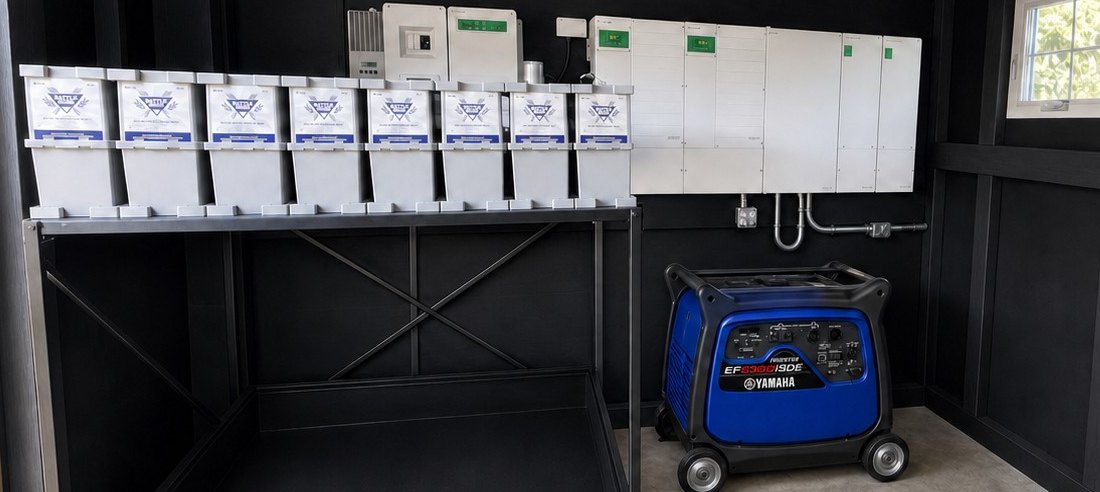
Propane-Configured Yamaha Inverter Generator · Schneider-Controlled Supplemental Power
Layer IV · Supplemental Power
Yamaha EF6300iSDE
Stable Reserve Power. Engineered to Wait.
The estate’s propane-configured Yamaha EF6300iSDE provides 5.5 kW of rated 120/240V power, with 6.3 kW available at maximum output. Its computer-controlled inverter produces tightly regulated electricity, while Yamaha Economy Control adjusts engine speed to actual demand. Integrated with Schneider, it remains quiet until called, supports the residence, replenishes the Battle Born bank and shuts down when reserve conditions have been restored.
5.5 kW RATED · 6.3 kW MAXIMUM · 120/240V INVERTER OUTPUT · AUTOMATIC LOW-OIL SHUTDOWN · SCHNEIDER-CONTROLLED
Maker & Details
The defining requirement for reserve equipment is not how often it runs. It is whether it starts reliably—and produces stable power—after waiting for the uncommon conditions that finally require it. Yamaha’s EF6300iSDE was selected because it combines durable small-engine engineering with computer-controlled inverter output in one integrated platform.
The generator is powered by Yamaha’s MZ360 four-stroke OHV engine. Unlike a conventional generator that must remain at a fixed 3,600 rpm to maintain 60 Hz output, the EF6300iSDE’s inverter separates engine speed from electrical frequency. Yamaha Economy Control therefore allows the engine to operate at approximately 2,600 rpm under lighter demand and rise toward 3,400 rpm at rated load. The engine works only as hard as the electrical demand requires, reducing unnecessary noise, fuel consumption and mechanical wear while reserve power is being produced.
The resulting electrical output is unusually stable for portable generation. Yamaha specifies frequency stability within ±0.1%, steady-state voltage regulation within 1% and waveform distortion below 4%. That controlled output is particularly well suited to the Schneider inverter/chargers, sensitive household electronics and the battery-replenishment process they manage.
Protection is built into the machine. A computer-controlled circuit breaker interrupts output if demand exceeds the generator’s capacity, while Yamaha’s Oil Watch system automatically stops the engine before insufficient lubrication can cause internal damage. Electric starting, automatic choke and the enclosed sound-reducing design further support dependable reserve operation. Yamaha rates operating noise at approximately 58 dBA under quarter load and 64 dBA at rated load, measured from seven meters.
At Benewah Estate, the Yamaha does not function as a separate appliance requiring owner intervention. Schneider monitors solar production, Battle Born reserve and household demand. When stored energy reaches a programmed threshold, Schneider starts the generator, accepts its output, supports active residential loads and directs available power toward restoring the battery bank. Once the programmed reserve has been replenished, the generator shuts down and the estate returns to normal solar-and-storage operation.
Its propane configuration adds another practical advantage: the estate does not depend upon maintaining a large reserve of stored gasoline during long periods of inactivity. Fuel remains connected and immediately available through two buried 1,000-gallon propane tanks.
Across four years of service, the generator has operated only about 100 hours annually. That limited runtime demonstrates the sufficiency of the solar-and-storage system—but it also explains why Yamaha quality matters.
Equipment that spends 99% of the year waiting must be dependable when the remaining 1% arrives—and durable enough to continue answering that call year after year. After four years, the estate’s EF6300iSDE has 600 operating hours (400 from current install configuration and 200 from other prior use). Using the owners’ prior Yamaha experience, approximately 90% of that operating-hour benchmark remains—mathematically equivalent to another three decades at the current rate of use.
The result is supplemental power built around readiness: Yamaha engine durability, load-responsive operation, computer-regulated inverter output, automatic mechanical protection, long-storage propane and Schneider-controlled operation working together without burdening the owner.

Solar and Battle Born carry the estate 99% of the time. Yamaha is built to answer the remaining 1%—year after year.
Grid Connection Always Available
Grid service was never unavailable to Benewah Estate. Neighboring properties are connected, and electrical service extends along the Benewah Creek corridor. Rather than connect to the grid, the owners chose to construct an on-premise renewable energy system because it offered greater control over the estate’s energy architecture, continuity during regional outages, freedom from recurring electric-utility charges and independence from external municipality infrastructural changes. That choice did not eliminate the grid. It merely left the option for grid tie-in open if and when desired.
A future owner may continue operating the estate’s on-premise renewable energy system or pursue a grid connection.
Related · The Resources